- Year
- Amsterdam, 2020
- Medium
- Rotring pen on museum board
- Size
- 96 x 133 cm
With whom Made in collaboration with Rutger Bregman and De Correspondent
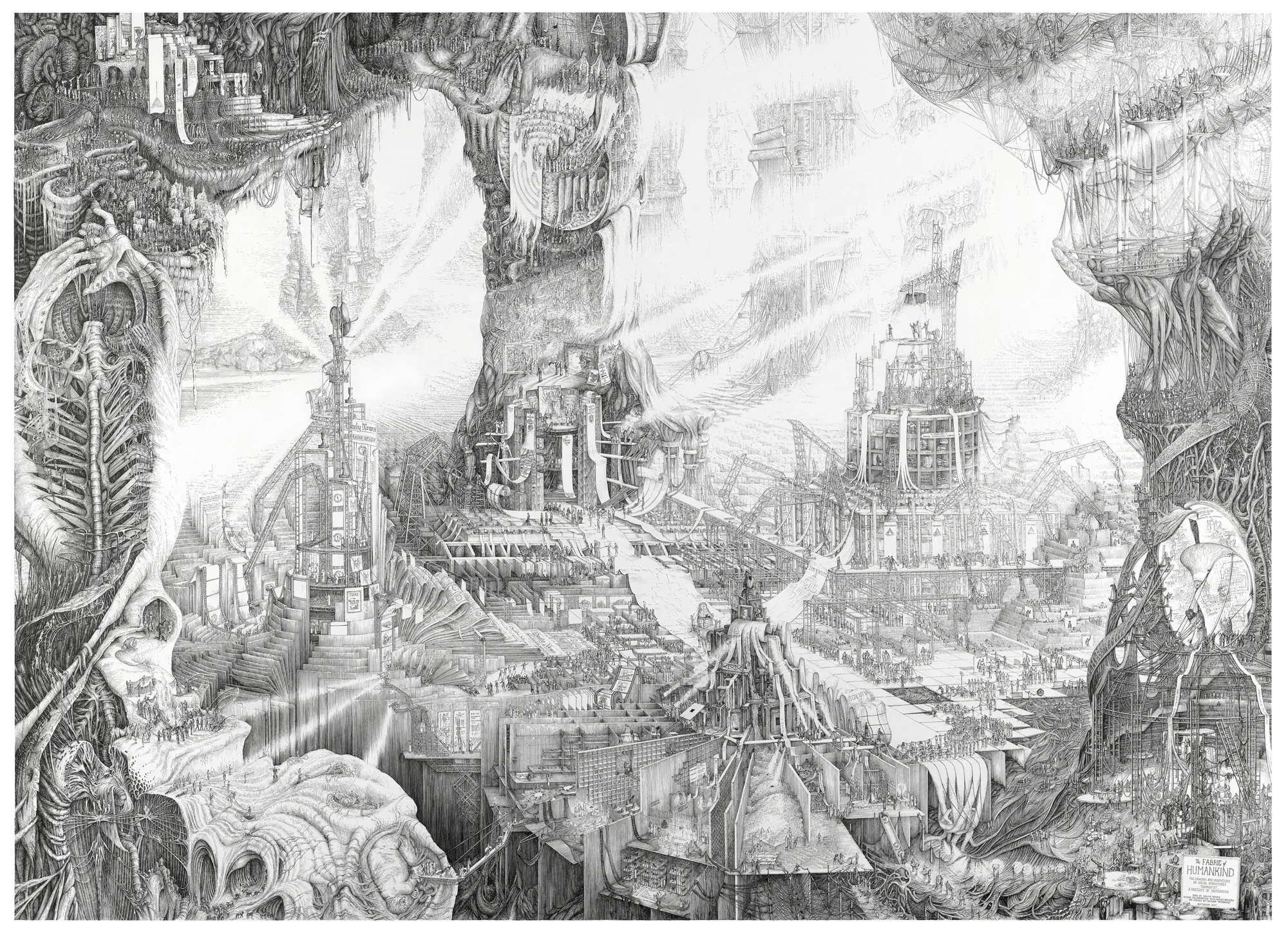
For centuries humankind has sketched our surroundings, creating maps to navigate this world. We assemble information to determine where we are, where we come from and where we want to go. This work depicts civilizations of the past and the now, in order to discover new future scenarios.
Exploring the space between art and science, this project allows for the emergence of something surprising from the liminal. When viewed from these two disciplines, a new picture may emerge. The Fabric of Humankind, the map that you are now viewing, was made by the cartographer Carlijn Kingma and historian Rutger Bergman, author of the book Humankind, with the support of the journalistic platform De Correspondent.
This is not a traditional map. You do not see countries and roads. You do not see mountains and rivers. This is a map of metaphors. A map with illustrations of ideas which juxtaposed, can provide new insights. It is just one map of one history with countless additional interpretations. In this audio tour I will make a first suggestion of how you could view the map.
Perhaps after this brief tour you will be inspired to wander the map freely, conducting your own explorations.
I invite you on a journey through a history of humankind; a history which starts with the growth of a single thread.
For hundreds of years, weaving has been a metaphor for the mystery of our existence. When you cross a thread or strand with another, and you keep on repeating that action, an infinitely complex web or weave comes into existence.
In the womb of this story, two types of fabric are illuminated – a literal biological web and a figurative social weave. The biological fabric is made of interwoven strands, like the DNA-strands of a double helix and the muscle tissue of our body. Here we see a fetus, still connected through the umbilical cord to the mother. There is virtually no being in the animal kingdom which is born so dependent upon others as the human baby. We are unable to survive without one another, and it is exactly this interconnectedness that forms the common thread throughout our history.
And thus, between the folds and wrinkles of time, we see the weaving of the social fabric. From the dark caverns, upward along the aorta, the first human species proceed. Above the chambers of the heart they fan outwards to inhabit different places on the planet.
How did the world look when we still lived as hunter-gatherers? A deep, dark fissure separates us from the world as it was before. Across that gap, researchers point spotlights upon our history. They are trying to find answers to profound questions, such as: who are we, and where do we come from?
Prehistoric fossils and skeletons show us that there were other human species. But what happened to them? Why are we, Homo sapiens, the only ones that survived? What is the secret behind our success?
As we travel further through time, we see a backbone and two reaching hands. When we started walking upright, our hands were freed in order to create and invent. We made countless discoveries and developed tools which we could use to shape the world around us. We developed speech and set our words into writing.
The written text is analogous to a woven fabric – it’s no coincidence that the words ‘text’ and ‘textile’ are similar. They share their origin in the Latin word texere, which means to weave. In the mythologies of the Dogon, a people from the Bandiagara area in current day Mali, the words ‘to weave’ and ‘to speak’ are even interchangeable.
As we zoom out, we see how our spine begets its strength and stability from our muscles and ligaments. The ligaments are the tight bands of tissue which spring outward from the spinal column. ‘Ligament’ comes from the Latin word ligare, which means ‘to bind, tighten or connect’. In this map, humankind’s primal and visceral urge of connection is illustrated by the bonding of the ligaments. We make bridges, ladders and sails to connect with one another. Standing with and upon the shoulders of our ancestors, we keep on making new discoveries.
The social fabric in which we are woven shapes our identity. Our relations with others are of vital importance and when we cut those ties, we are set adrift. ‘Emancipation’, writes the French philosopher Bruno Latour, ‘doesn’t mean “free of ties”, but well attached.’
Throughout the millennia, we have improved our ability to collaborate and trust one another. On the map we see the ligament threads weave together creating a stronger whole, much as the connections between people combine to form society. Ladders are assembled making previously inaccessible places now reachable. The ladder appears in many cultures as a metaphor – from ladders in religious texts which lead to heaven, to ladders in self-help books which assist you in reaching your potential.
Throughout the majority of our history, people have lived mainly in small groups. Yet still, nomadic peoples would come together for a communal project. In the map we see people dancing in a circle, celebrating the creation of an enormous temple complex, where, for many decades, thousands of pilgrims have gathered and collectively constructed.
But then, only a short time ago in our history, everything changed.
In between the fertile riverbanks of the Euphrates and Tigris, groups of hunter-gatherers began to permanently settle on fertile land. They built settlements and worked the fields. For a long time there seemed to be enough for everyone – see the fat seeds and juicy fruits – but the population grew rapidly. With the passing of time, more and more people started to claim land for themselves. Where we had accrued social relations for thousands of years, we now started to collect possessions.
Meanwhile the fields became exhausted, the most fertile pieces of land were fenced-off and a period of scarcity began. On the map we go from a horn of plenty to a ribcage, all skin and bone.
Villages became cities. Cities clustered together into provinces, and the first nationstates were created. The ties which united us became the ties that bound us. The threads of the fabric were taken by a small elite, which ruled with an iron fist over its subjects and turned people into slaves.
The state here is represented as a tower. At the top of the tower, stories are codified to legitimize the hierarchical inequality. An organizational principle derived from the lay-out of an organ, the brain, to appear as a natural phenomenon. Whenever stories are questioned by people down the hierarchical structure, the state reacts with systemic abuse. A bit lower in the tower we see the social fabric being ripped apart – families, groups and subcultures disintegrate – by the creation of the state. From now on, with their hands tied, individuals are forcibly placed into the social hierarchy.
At the bottom of the tower we see the lowest class, coerced to its knees, conscripted to dislocate its own collarbone. The shoulders derive their strength from the collarbone; they enable us to carry a load, to put our shoulder under something, to walk upright, with character. But that freedom has now been lost. On the right we see how the dislocated collar bones of the working class are refashioned to support the so-called ‘civilisation’.
But then, on the right-hand side of the tower, we see the grip of the state weaken. We witness the unravelling of the social hierarchy. The enslaved and the subjected citizens free themselves from their ties and start looking for new connections. For a long time we assumed – or we were told – that the collapse of a civilisation would be followed by dark times of chaos and anarchy. However, for many this unravelling of society was in fact a liberation.
Down on the left, we see someone escape from civilisation. Benjamin Franklin, one of the Founding Fathers of the United States, was one of few who dared to admit: ‘No European who has had a taste of the Wild Life’, he wrote, ‘can afterwards tolerate living in our society.’ If a ‘civilised’ white man was kidnapped by a native American and then freed, he would, according to Franklin, ‘at the first opportunity escape again to the woods.’
Now we come to another thread in our history – the thread of religion. Religion, stemming from ligare, shares the same etymology as ligament: to bind, tighten and connect. Initially it aimed to fulfil a similar role in society: stitching and strengthening the social fabric. In the map we see how human belief in spirits and gods was woven to become a solid institution. Take Christianity for example: what began as a rebellious philosophy solidified into a hierarchical organisation. What started as a living, oral tradition was laid down in written texts.
In the top-middle of the map we see how priests are weaving a blanket from verses of the Bible. The blanket has a labyrinth stitched onto it: the path of the pious life. Above that we see the all-seeing eye of God, who can read everyone’s thoughts. The rulers spread this ‘blanket of piety’ over the consciousness of the people, represented by the gigantic brain in the skull-like bowl. Acolytes follow the path on this blanket. Thus the rules of the belief are traced deeper and deeper in our brain, like well-worn paths.
But then, further on, beneath the unraveled structure we see here, in the middle of apparent chaos, is a printing press amongst piles of windblown paper. The invention of the printing press marks the end of the power of the old church and announces the advent of a new era.
We descend to the centre of the map to find the Enlightenment, the revolutionary movement which three centuries ago laid the foundation for our modern western world; from democracy to the constitutional state, from education to science.
The Enlightenment thinkers believed that religion couldn’t advance us further. They put their faith in Reason. ‘Knowledge is power’ became the credo, and our future society seemed to be one that could be shaped and engineered.
On the map we see how society is being rationalised. Wild tangled hair is combed out and cut away. Chaotic fabric is tied up and removed. Blueprints are rolled out over society. Splints are put under the social fabric, now assumed to be weak, and in need of support.
In the light, on the right side, we see the immense progress which is achieved because of this: mass production and economic growth, standardized house-building and the development of infrastructure. People are pulled out of chaos and poverty to receive food and shelter.
But the Enlightenment has a shadow side. When you sprain your calf or break a bone, putting splints on your leg can help recovery; however, when the splint isn’t removed as soon as the tissue has healed, then your muscles and bones stay weak. Just as when a permanent splint on your leg can lead to serious forms of muscle atrophy, the social fabric also becomes weak if people are regulated too much.
What’s more, you cannot rationalise everything, as we can see on the left-hand side. Take rationalisation to the extreme and one gets a machine with people being pigeonholed and excluded. The most modern technological tools equally bring happiness and prosperity with hate and destruction.
We see the registration of citizens and efficient train transportation by a well-oiled bureaucratic machine. Again the social fabric is combed out, and again people end up boxed and classified. Rationalization has not only brought us prosperity but also one of the greatest atrocities in our history: The Holocaust.
Here starts our guided tour through the modern world. It’s a mechanized world ruled by media, politics and science. We first look at the tower of the media, which day in and day out produces images of who we are.
The press has crane-like mechanical grapple which makes a selection from all the possible stories and countless interwoven events. The selection is made mainly of sensational scenes, intense and exceptional events and absurd incidents which are cut out of context.
These fragments are assessed and cut, blown-up and juxtaposed on a larger canvas. The patchwork collection of exceptions and incidents, also called ‘the news’, is printed and distributed, consumed and shared. In front of the newsroom we see the sections of the newspaper infiltrate into society. The lines form the template of echo chambers of the like-minded.
We now shift our gaze from the media to the political system – to the establishment, represented as a tower of power. We see a system that is based on mistrust, where a small elite rules, and stability is guaranteed through control and violence. Also here we see mechanical grapples steer and regulate from above.
We see a society which is stuck in a negative spiral: only those who colour within the lines and check the correct boxes will be allowed to ascend the ladder. The route to the top, one of elbowing and shouldering, influences the world view of the rulers. They are corrupted by their power, and then create the society in their image. Patterns of expectations become reality. The people acquiesce, conforming to being boxed and penned, walking slavishly along the well-trodden paths, too busy, too tired, too afraid to step away and pursue new arteries.
If you work hard enough, you will get there – that’s what we are told time and time again; but do we all get the same opportunities? Through a complex of corridors consisting of moulds and expectations, we see how each of us is given a place in a world where once we were born free; but one in which many are burdened by the oppressive feeling that they are stuck in a machine.
Or is there a change in the air?
We now look at the building of science, where new halls are walked. We see many researchers who ask themselves the question: what does it really mean to be human?
In an oval building stands a tower of paintings, the gallery of honour where thinkers from the past are immortalised. Around them, below, science is growing and expanding. Throughout the centuries more and more paintings – scientists, ideas and theories – are added. The flowing sheets of paper that are draped over the paintings, resulting in different faculties, show how the thinkers have embroidered upon each other’s works.
For centuries many researchers have had a sombre vision of man, but meanwhile science has made some progress. The walls between the faculties are getting lower and there is more interdisciplinary collaboration. We see researchers looking over the edge and beyond their traditional frameworks. Archaeologists and sociologists, biologists and psychologists come together to new conclusions about the nature of humankind. They emphasise that, in essence, we are connected beings and have an essential need for carnal contact.
At the same time, it is a paradox: we are capable of the most terrible things. Perhaps, as scientists suspected, our empathy and xenophobia are mutually connected. Perhaps they are two sides of the same coin. We are capable of doing the most terrible things in the name of friendship, loyalty and comradery.
We arrive at the edge of society as we now know it. At the intersection with the future: the present moment. The now.
It’s a world in which we have become richer, safer and healthier than we have ever been. The Enlightenment has ushered in unmistakable progress. Yet at the same time we live in a world of great inequality, where the fires of hatred and racism still burn, on a planet which is rapidly heating up.
How long can this go on? And what will our future look like?
Maybe it is exactly now that we are in need of new dreams – not mechanical blueprints that we cannot deviate from, rather through multiple sketches of alternate scenarios. ‘A map of the world that does not include Utopia’, wrote Oscar Wilde, ‘is not even worth glancing at.’
The word ‘Utopia’ is a contraction of the Ancient Greek words ou and tópos, which put together mean both ‘good place’ and ‘no place’. Utopia does not exist in this physical world, but only in our imagination. It is an alternative world to which we aspire, one to which we may proceed onward.
We zoom in on the pioneers and trailblazers who are now showing that things can be done differently. They are trying to escape the logic of the machine and instead to embrace the logic of the organism.
With a machine one can only follow the demarcated path. Everything is black or white, 1 or 0, yes or no. A machine is characterised by immutability and standardisation. From the moment a machine rolls off the conveyor belt, it starts to decay. It cannot become stronger; time, nor stress, nor pressure will toughen it.
Organisms only exist by virtue of their response to outside influences; they are not static. Continuous variation and adaptation is absolutely essential. Both fabrics, the biological web and social weave, derive their respective strength and vitality from their interdependent fibres. Organs and organisations are the result of their collaborative fabric. These fabrics and tissues become stronger when put under strain or pressure – think of muscles and calluses, traditions and character.
In a society which is perceived as a machine, citizens will become small cogs and wheels. They have to work more and more efficiently and recharge in their spare time. Continual growth becomes the highest good.
Instead consider the economy as an organ, and see how your perception tilts. When one speaks of continual growth in an organ, we speak of cancer. The nature of humanity collides with the characteristics of the machine.
And thus we look towards a future which is imagined as an organism. A fabric or tissue which is characterised by collaboration and connectedness, interdependency and diversity. A fabric which grows from the bottom-up and cannot be mapped out from above. Progress must be the result of countless experiments, which are allowed to fail – hence all the networks and safety nets, symbolising the strength of our social fabric. There are no loose ends in a strongly woven net. In the network of a strong community we do not abandon one another.
We are going from walls and boundaries to bridges and connections; from sheltered enclaves to open networks; from a rigid grid to a semi-lattice framework; and from arms that grab to hands that carry. The fabric doesn’t become weaker through the interwoven threads. No, it actually becomes stronger through dependency. Stronger through collaboration. Stronger through trust.
In this way the fabric of humankind continues to grow, off and beyond the map, into the future.
I’d like to tell you that this story lifts only a tiny tip of the veil. If you are curious and look, you can discover many more connections and metaphors, figures and events.
Finally: this map is a personal, highly subjective vision. What we see always depends on where we stand. In the distance there are other towers. Those are other histories, other truths and other ways of seeing.
With whom Made in collaboration with Rutger Bregman and De Correspondent
OngoingExhibition
Rijksmuseum Twenthe
The Fabric of Humankind
In permanent collection
4 november 2020Event
Pakhuis de Zwijger Livecast: Rutger & Carlijn.
Carlijn Kingma & Rutger Bregman in gesprek over Het weefsel der mensheid.